Sunday, 13 September 2015

Going with the flow

Just after 7 this morning Nigel was ready to usher us down his lock on to the River Ouse. The tide seemed to be running less swiftly than it had been last night – he said it was just beginning to build.


The gates began to open to give us our first river-level view of the flow.
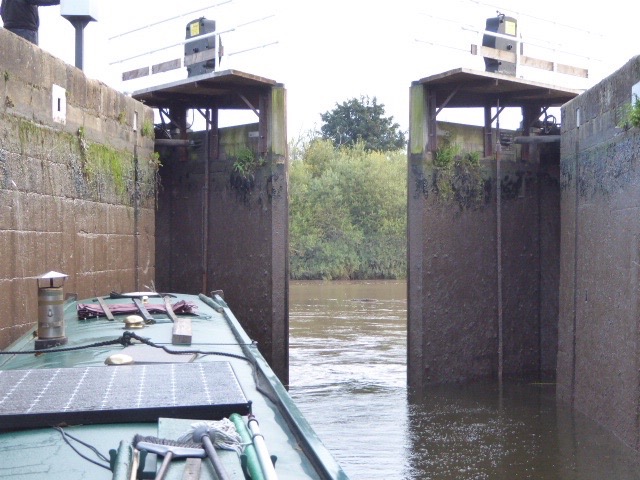

As we came out the current caught the bows and swung us round. The right hand hand of the boat dipped under the pressure of the water. That was a bit disconcerting – I somehow had been expecting Erin Mae to keel over to the left.


At this point there was a bit of debris in the water, which we tried to avoid.


This was nothing, however, compared to the huge logs we had to steer around as the journey progressed.


Apart from that there were not many obstacles – two bridges at the start and one in the middle of the tidal stretch, which had to be negotiated with care.


It was actually a fine morning, once we relaxed enough to enjoy it a bit, though it was pretty chilly.


Quite a lot of the river was edged by banks too high to see over, and about the only thing of particular interest was the constant task of avoiding the floating debris and keeping out of the shallows. Eventually, however, after about two hours, we caught our first glimpse of Naburn Lock – the end of the tidal section. We were accompanied in the lock by the boats that had been released from Selby after ourselves.


Naburn lock was having an Open Day.


Volunteers have been restoring the buildings housing a forge and a workshop, which used to manufacture tools for local farmers and industry, as well as for river operations.


It's a nice setting, and we thought about stopping here, since we were unsure about the availability of moorings in York.


In the end, however, we decided to push on, taking advantage of the weather, which was getting better by the minute.


We passed an ingenious sculpture attached to a bridge, and a Bishop's palace.


We came under the Millennium Bridge, where streams of cyclists were participating in a York charity event.


A little further on we found the cyclists crossing over a dubiously navigable branch which you enter at your own expense and peril.
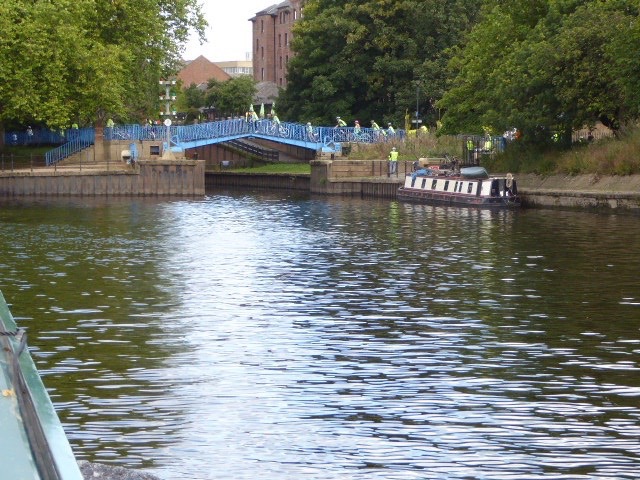

A few more bridges bring you to the heart of York,


where you have to watch out for boats considerably smaller and considerably larger than Erin Mae.


We've tied up at the best moorings in town, by the museum gardens. Space was limited during the day because of contractors doing work on the moorings, but we breasted up to NB Isobel at the invitation of its crew, who then moved on after a couple of hours to leave us well set for the night.

So the tide had fewer terrors than feared, for which we are thankful. Of course, we now have to do the return journey, later in the week, and negotiate the turn into Selby Lock with the river rushing Erin Mae downstream. Time will tell!

Saturday, 12 September 2015

Selby – abyss and abbey

Selby Lock looks attractive from some angles, especially with its twin cottages on the far side.


But when you walk to the bottom gates to see where you're going to go, you stop thinking about how attractive it all is in the sun.


It would clearly be impossible to get into or out of the lock when the river is low, because of the mud flats.


Looking upstream is the same – what the photo can't show is how fast the current is moving, and it will certainly require some nifty steering when we return from York later in the week. This section of the River Ouse is tidal, even though we're 16 miles upstream from Goole, which is where it runs into the Humber estuary. So we rely on the lock keepers to tell us when to exit the lock (7.30 tomorrow morning) and when to leave the one upstream at Naburn on the return journey, so that we arrive here with a reasonable depth of water for the turn, but with the current not running too fast, so that we can turn back into it as we approach and make the junction.


Locks this deep are scary enough at the best of times, let alone under these conditions. Having to work out how to balance the flow of the river with the effect of the tide has been taxing my brain all day long. 


So to calm our (my) nerves, we went for a walk into Selby to visit the Abbey. It's a striking building (in fact, if Selby will forgive me for a comment based on extremely limited experience, about the only thing of note in the town, apart from the Olives & Grill restaurant, which looked as though it could be a good place to eat sometime). It was apparently started in Norman times and finished in 1935! It was full of interesting bits and pieces and features (if you like that sort of thing). It was just a little short on space set aside for sitting still and reflecting quietly.


The bell ringers were high up in the central tower, about 80 steps high, I think. This afternoon they were giving it all they could, doing a peal in honour of the Queen becoming the longest-reigning British monarch. It was a pretty splendid sound, and it went on for a long time, and to my untutored ear it seemed as if they were doing it extremely well.

So tonight we are back on Erin Mae, enjoying the quiet of this spot – a bit of calm before the turbulence of tomorrow.

Friday, 11 September 2015

The longest day

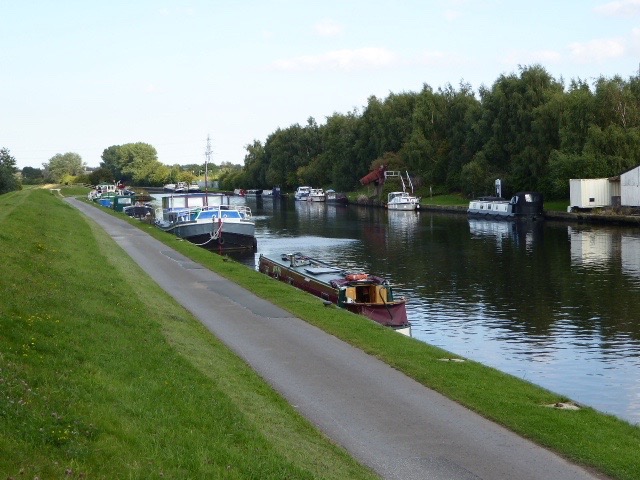
The Aire and Calder Navigation is mostly big and wide.


Leaving Castleford this morning we encountered very little traffic, let alone the huge barges full of coal that used to service the power stations


We only had to negotiate one automatic, key-operated lock. Two of the others we encountered were flood locks, permanently open while water levels are relatively low. But after about 6½ miles we turned left at the junction with the branch up to Selby, and found ourselves back in manual territory.


There were only two that needed to be worked, but they were really stiff. One gate beam needed both of us to move it. For a while we were on a section of the River Aire as it followed its own meandering path, carrying the risk of going aground if you cut a corner too fine. But after a while we went through the final flood lock and found ourselves on the Selby Canal proper.


It was narrower and straighter than the river section, but not all that interesting as it was hard to see beyond the trees lining the banks.


This feller wasn't interested in the view to the side, of course. He was interested in finding his dinner in the water. I'm not sure I've seen a heron fishing from up a tree before – most stand on the bank. We also saw cormorants silhouetted black, and the blue flash of a kingfisher.

We'd noted some mooring-up places in the guidebook, but none were very appealing. In the end we were making good time and got all the way to Selby, tying up in the basin just before the lock that leads down onto the River Ouse. We'd done it in about 50 minutes less than the CanalPlan website suggested it would take. We've done six hours boating before when we needed to, but I don't think we've ever covered over 18 miles in one day.

So now we have a day in hand before we head onto the river – the first tidal section we'll have ever done. Better find something interesting to do tomorrow to take our mind off the terrors of the flood tide, or it might be an even longer day than today!

Thursday, 10 September 2015

Coming up for Aire

After our rest day in Leeds, it was time to bid farewell to our city centre mooring and go down the remaining lock of the Leeds & Liverpool canal, onto the Aire & Calder Navigation.


True to form, it poured water from leaky top gates all over Erin Mae's stern, but we finally made it through, before turning into Clarence Dock, next to the Royal Armouries Museum.


We'd visited this museum yesterday, following recommendations from guide books and a boater, but I didn't enjoy it. For me, war is a very ambiguous thing. There's a age-old tradition of a "just war" argument, and it's easy to posit questions about what you actually do if someone attacks you or yours, or acts with appalling cruelty. How should you respond to acts of genocide? Etc. But it all leaves me feeling profoundly uncomfortable, especially because as soon as I settle on a position to adopt, I can easily start picking holes in it. The museum by no means sets out to glorify war – far from it. In fact, it even makes space for a small pacifist exhibition. But you can't exhibit and describe armament and weapons from the last few centuries without celebrating the technology, and to some extent simply accepting that this is what is.

Anyway, today we were there to fill our water tank, while my best beloved walked a few yards to get her head around the first of the automated locks on the A & C.


They work with a key, and have buttons to press in sequence, with lights to indicate what stage the lock thinks it is at. Unfortunately, this very first lock was not playing ball. No lights were showing, and nothing seemed to happen. Eventually I crossed the canal to the local CRT office, and they promised to send someone across to see what was wrong.


Andy came over, re-set something, used his magic key, and everything was fine. Thanks, Andy. You're a star!


The Leeds and Liverpool was a wide canal (for boats up to 14 feet wide), but the locks, being short and normally leaking considerable amounts of water, felt positively claustrophobic. Not so the Aire and Caulder. Parts of it at this point are the actual River Aire, and even when that is diverted and you're in a cut, it is wide enough to feel like a river.


It was also far more interesting than when we cruised down the River Severn a couple of years ago, because you can usually see beyond the hedge, and over the surrounding fields or hills.


The locks are designed for commercial craft to come up to Leeds, so they are big.


After those on the L & L they felt like an Olympic rowing course.


But they are not unattractive, and Woodlesford Lock even had a whimsical donkey admiring the flowers.


So we came down to Castleford and turned left. In spite of its name and Roman origins, I've always associated Castleford with hard men and rugby league, thinking of it simply as a Yorkshire industrial town. So our mooring is a bit of a surprise. Just over the bank there's a field with bales of harvested hay. It feels quite rural.

I just hope that boat in front of us doesn't accidentally slip its mooring in the night, and drift down towards us. I suspect Erin Mae would come off second best!

Wednesday, 9 September 2015

Exhibition

Leeds is a solid Yorkshire town.


A solid iron, presumably Victorian, bridge spans the canal just down from our mooring.


A solid Victorian church reaches to the sky. This parish church has recently been entitled "Leeds Minster", a church warden informed us, for some reason which he seemed not entirely to understand or to sympathise with. The building is unusual, in that the entrance brings you to a point between the nave and the chancel, which are of equal length, so you're half way up the church as you enter. It also has galleries, more commonly seen in non-conformist churches of the period, where preaching was centre stage.


The older buildings in the town are also solid, and quite a contrast to the more recent additions. I didn't think it was an entirely happy mix.


We made our way to where the town hall sits. It was hosting a wedding today, though concerts are its more usual fare.


We decided on a cultural infusion, and started in the Henry Moore Institute next door but one, dedicated to promoting the art of sculpture. It has an exhibition entitled "Palpable Sculture: Paul Neagu". Neagu was a British-Romanian sculptor, and his idea with palpable sculpture seems to have been to make it multi-sensory and deny the pre-eminence of the eye. Now the pieces we saw were very enjoyable and interesting, but everywhere there were signs saying: "Do not touch the exhibits". That struck me as being the complete antithesis, not only of what the artist was intending, but also of the actual title of the exhibition.

So we left, a little disillusioned, and moved on to the art gallery next door. We spent a while, up and down in the lift, trying to find the art, but we mostly found the library and the café. However, we did find a gallery full of Leeds tapestries, celebrating the town, and done by various people and groups to a standard size, mostly involving a good deal of collage. They were good fun. But by the time we got to the end of the gallery, we were suffering a bit from two cases of "museum leg" and decided to call it a day without actually going inside the town hall.

After a restorative cuppa back on Erin Mae we realised we should probably buy some foodstuffs being leaving Leeds, and located a Sainburys Local in the train station. That's fairly close to our mooring, so we popped along. And there, in the station outside the shop, was a piano with "Play me" plastered all over it in about 50 different languages. I couldn't resist.


Well, I haven't played a piano since we started this cruise. The only NT house we've visited didn't have one. So I spent a very contented 15 minutes or so, keeping other would-be exhibitionists off this instrument. It wasn't the highest quality, but it had been properly tuned. Mind you, I'm not quite sure what happened to railway ticket sales from Leeds during this period.

Tuesday, 8 September 2015

Blessings

On this grey, dull day, as we completed all but the final lock of the Leeds and Liverpool canal, we've had good cause to be thankful.


We had two more triple staircase locks to go down, but they had seasonal lock-keepers.


Craig had been a school teacher, but decided to swap it for this role. This is his first season of keeping the locks trim, in good working order and free of weed, and of helping boaters through the first staircase we encountered.


Paul was on duty on the second staircase. With a background and family in Tasmania, he's looking forward to heading out there in November, when the lock-keeper season has ended. Both of these guys were friendly and helpful, and made it much quicker to get down the flights.

As we approached the next, single Kirkstall lock, which we had been told could be a bit tricky, we found a boat emerging from it – a remarkable event since this and the one behind waiting to come up were almost the only boats on the move all day long. As it happens, the two women who were operating the gates were from the boat behind, and ably assisted us with a quick descent.

We had one more double staircase to do, and this time got into a bit of a pickle. Somehow we managed to leave a set of paddles open that should have been closed, and only noticed when I was half-way down in the first chamber. That meant a speedy closing of all paddles, followed by taking Erin Mae back up and starting again.


But once again we were not without help. Derek (on the right) is an experienced boater, and lives in the old lock-keeper's cottage. He came out to push and pull and turn and help us through. Don, cycling the towpath but stopped for a while, also gave a hand.


So tonight we're tied up at Granary Wharf in Leeds, in the middle of a new restaurant / hotel / business complex.


The final lock, just yards away, is called River Lock, and leads down onto the Aire and Calder Navigation, which will be a different affair altogether. Tonight I emptied three buckets of water out of Erin Mae's engine compartment – the consequence of having had to sit back right under leaks from lock gates, paddles and other structures. I'm just hoping that, when we go down River Lock tomorrow or (more probably) the day after, it doesn't turn out to be the worst of the lot and fill the compartment up again.

Meanwhile, I'm thankful that we've just about made it along the L & L!