Wednesday, 11 May 2016

12 volt electrics, continued

Some of our friends wouldn't dream of having a TV on their boat, but there's the most wonderful summer of sport coming up. Erin Mae came with an LG 26" analogue TV, all nicely framed with shelves for, among other things, CDs (remember those?). At the time of the digital switchover, our not-so-youthful eyes were beginning not to see all the detail on our 26" Sony TV at home, so we bought a new one, and installed the Sony in Erin Mae. The two flies in the ointment were (1) the variable signal from the omnidirectional aerial; (2) it's a mains model, and so needed the inverter on – the downside of which I described yesterday.

We decided over the winter that, if we were going to have a TV, it should be a 12 volt version, so the Sony went home and we bought an Avtex. It's a bit smaller than the previous occupiers of this space but, with a suitable bracket behind, is suspended nicely in the air.
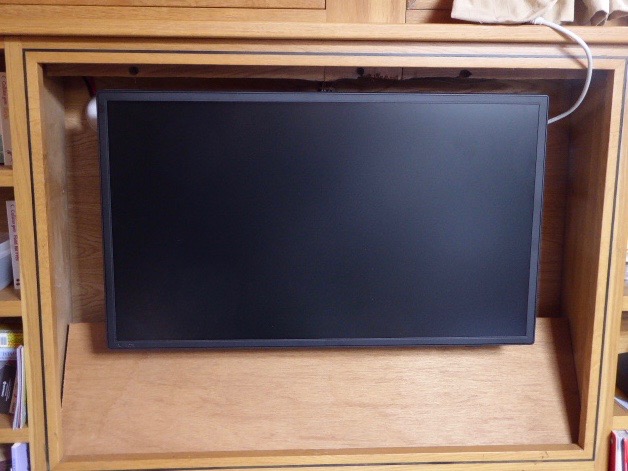

A small piece of oak-veneered something-board left over from my wardrobe doors nearly 30 years ago covers lots of holes and wiring. Just behind the set, top left, can be seen the 12 volt socket that we installed for power.

When we came up after the winter the aerial didn't seem to be functioning at all, though we don't yet know whether that's just Great Haywood's reception problems. We adopted a multi-targeted approach. I had a spare wideband aerial, and rigged up a frame with some magnets for it to sit on the roof. That's working well – the best reception we've ever had here. The trailing lead in through the window can be seen in the photo, but we're hoping this will be a temporary / occasional arrangement. Since the TV also has a satellite input, I've acquired a satellite dish for areas (we've encountered a few) where Freeview just doesn't work, usually in those places we've reached just as Wimbledon starts. I suspect it will prove quite a hassle to get it set up – I'll be asking people we meet along the way for advice.

That's just about it for 12 volt devices. The list of what won't work includes the electric toothbrush, my own ancient mobile phone and two nice little reading lights from Ikea – I haven't yet found anything that might replace those. The automatic lighting for oven, grill and hob needs 230 volts but the oven and the hob, though not the grill, will work once lit.

Now we have to get out and about to test it all in the wild. Unfortunately, the weather has been miserable and we have things that require our presence on the south coast at regular intervals. Some day soon…

Tuesday, 10 May 2016

Electrical action part the enth

Actually, part the nth, but it seems you can't do superscripts in a blogspot title! Part the first was 25th November last year. I expected part the second to follow quickly, but delays in the work and other issues meant it never materialised quite as intended. Other posts since have occasionally included something about the electrics, so part the nth it is for this one.

It's always been a frustration that we couldn't moor Erin Mae up for long without worrying about the batteries. It's no way to treat your engine, running it just to charge them. I'd be thinking about them overnight, and then checking them first thing in the morning. As often as not they'd be down to half-charge, and I'd have to start the engine. That would strike us as a waste of diesel, and we'd feel the pressure to cruise for a few hours. So, in addition to the battery worries, we'd be moving when we hadn't really wanted to. So much for this relaxing life-style!

Part of the problem was that I couldn't rationalise the drain on the batteries. Measurements with meters gave only half-helpful figures. I suspected that the main problem was the fridge, which needed the inverter on 24/7 to provide it with 230 volts. In the end I tested it by turning the inverter off overnight, hoping the milk wouldn't be sour in the morning. The drop in consumption was dramatic. Significantly, just turning off the fridge while leaving the inverter on achieved little – the inverter itself needed to be off.

So this got me thinking about eliminating dependence on the inverter, so it could just stay off most of the time. The washing machine and the Dyson vacuum cleaner seemed reasonable exceptions, since they would be used just occasionally and (especially the washing machine) only when cruising. But my computer, the mobile broadband wifi router and my best beloved's phone and iPad can all be run from 12 volt outlets. I also found a suitable AA / AAA battery charger for my rechargeables. So we've installed two 12 volt outlets in what will hopefully turn out to be a sensible place, at one end of the kitchen area.


The one on the left will be permanently in use for the mobile broadband / wifi. The other is easy to reach for charging various devices. I've put an Ikea spice rack just above, to carry splitters and cables and the chargers for computer and rechargeable batteries. It was an obvious choice, since I've just fitted a couple at the other end of the kitchen for their proper purpose.


Ronseal satin "natural oak"woodstain matched them up nicely with the interior panelling. Meanwhile the new 12 volt fridge has fitted in a treat. It may have been expensive, but it's much better than the old Daewoo.


Most of the smaller devices actually run on USB voltage (5v, I think), and so appropriate cigar-lighter type plugs have a USB socket as their output, and an internal circuit to drop the voltage. That means they're on when in place, even when nothing is plugged into them. The draw will be minimal but it will be good practice to remember to remove the whole plug when not in use, not just the USB cable.

Tomorrow, part n+1th, but how I'm going to put that in the title is as yet not certain!

Monday, 9 May 2016

Delays and developments

We had only a few days on Erin Mae in mid-April, and various commitments kept us in the south for longer than expected. But we were able to come up a couple of weeks ago for a few days, and again on Saturday, continuing with preparations for this year's travels.

My research into under-sink water filters was interesting and successful. I found a supplier with the exact model of the casing I had cracked. That's now properly installed, and the water flow is as fast as it's ever been – so fast that I even went back to my research to check I was using the correct filter element.

We've almost completed the conversion to 12 volts of all possible systems. The first indication that everything is going to be hunky-dory came following what could have been a calamity. During the winter I'd left a small heater on anti-freeze duty, only to find on our first spring visit that it had used up all the mains electric from the meter. We arrived too late in the day to get a top-up from the marina office, but the SmartGauge showed the batteries were fully charged anyway. One up for the solar panel! We had some perishables with us, so we decided to turn on the new 12 volt fridge and see how things went overnight, with just the batteries for power. In the morning the SmartGauge showed 85% – under the old regime with the inverter running a 240 volt fridge the batteries would have been well down by the morning.

I think technical reports are best in small doses – so I'll continue the 12 volt saga tomorrow, as my blogging gets up to speed for the season.

Wednesday, 13 April 2016

Oh the winter it is past…

…and the summer's here at last. Well, not exactly, but that's how it goes in The Curragh of Kildare which, as it happens, I sang to a group of friends last weekend.

And since the winter is indeed clearly past, we've come up to Erin Mae to reverse all the protective measures we put in place in November – fill the water tank, check all the water pipe connections, turn off the opened taps, refit the water filter, and turn on the water pump. It mostly went smoothly, except for the water filter under the kitchen sink. Screwing the cover up I didn't realise that the ceramic filter inside was out of position and being forced up against the edge of the recess into which it is supposed to fit. Eventually there was a crack and I found I'd broken a piece inside. It doesn't prevent us getting water from the tap, but the speed of flow suggests that it's bypassing the filter. My guess is that spares are not available and I shall have to buy a complete new unit.

Ah well, so long as it doesn't cost me as much as I would have paid to get someone else to winterise and de-winterise our pride and joy, I shall be in pocket in terms of hard cash, and considerably in credit in terms of experience.

Friday, 25 March 2016

Back to blogging

I've been reading, rather enviously, the blogs of those who are on the move. Our time will come! But it will probably be two and half weeks before we make our first run up to Erin Mae, to see how she's faired, get the bedding back on board and complete some of the 12v electrical work. And it will probably be early May before we leave harbour.

The winter months have been anything but idle. Lots to do and to think about, but this blog is for boaty stuff. So I decided to resurrect a different blog I set up when doing a course about on-ine learning. That will give me the chance to write about anything I want. Who knows, someone else might read it from time to time!

If you're interested, you'll find the Everyday Fractals blog here. Or there's a link to it on the Erin Mae page.

Sunday, 6 December 2015

Lagging

In follow-up comments to my post about winterising Erin Mae, Halfie expressed surprised at my statement that the boat's calorifier is not lagged. Which got me thinking and googling. I found that one chandlers describes its calorifiers as having 25mm of polyurethane foam insulation, inside the shiny blue exterior.

I don't think I even considered internal insulation when I wrote my comment, which is odd because the hot water tank in our house certainly has it. But I suppose most modern calorifiers must be constructed this way – I just hadn't thought about it when it was installed. I have memories of houses from decades ago having separate lagging jackets needing to be tied in position, and that was what was in my mind. On Erin Mae, water heated the night before does indeed stay warm enough for a morning shower, so I guess the calorifier must be insulated. Obviously my analysis lagged behind the reality.

Do any of my readers use external lagging?

Friday, 4 December 2015

Home maintenance

We had Erin Mae out for five months this year. A great adventure! But it meant that certain things off the boat had been left for five months without our care and attention. First up was the car. But, as I reported when we got back to base, the solar panel had done its job and, after a moment of uncertainty, the car woke up and behaved perfectly.

The house was generally fine and we'd arranged for some visits by various people, to cover the niceties of the insurance. But, shortly after getting home, we realised that the downstairs toilet, while flushing OK, was gurgling a bit. Some drain research was in order. Removing one of the manhole covers revealed some water that was not draining away as fast as it should. At this point I benefited from maintaining friendly relations with the college down the road where I worked for 25 years before retirement. A quick phone-call to check, and I was able to go in and borrow their rods, which soon resolved the problem. It wasn't a major blockage – but presumably five months of not very much flow had provided an opportunity for some sludge to build up. So I did the home maintenance equivalent of dredging.

Finally there was the gas hob. Three burners were working fine, one was doing nothing at all – not even smelling a bit. So today Mike the gasman came and poked around. A jet was blocked and his poking mostly cleared it. But I was puzzled about where a blockage could come from. What could possibly be emerging from the gas-pipe that could do that? Mike, with his years of experience, pointed out the dust that had been expelled, and philosophised about the wisdom of the gas people no longer putting filters in the places where they'd been installed for the past 100 years until someone decided they weren't necessary any more. He also said that, if he hadn't been able to fix it with a bit of poking, it wouldn't be cost effective to do a proper repair – it would be cheaper to buy a new hob.

I reckon we got off pretty lightly, given our five months of inattention. But I'm not sure there's much we could do differently next year, apart from finding a friendly neighbour to come in once a week to flush the loo and burn a bit of gas.