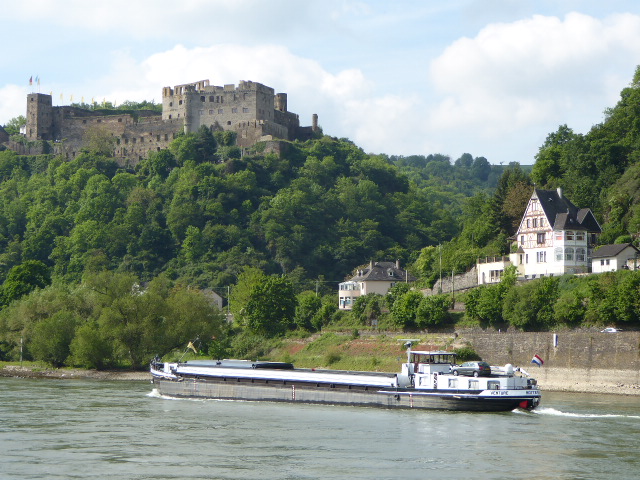
Friday, 26 May 2017

Gutenberg

Our little ship arrived in Mainz at breakfast time, and we had most of the day for exploration. One of its attractions is the Gutenberg museum – Johannes Gutenberg was the man renowned as the one who kickstarted letterpress printing in Europe, and among the main treasures of the museum are two copies of the original Gutenberg Bible, from the mid-fifteenth century.

gutenberg-bible.jpg
(Photo courtesy of The Gutenberg Museum website)

The museum is about printing in general, with info, among many other things, about how the Chinese did it as early as the 5th century.

Mainz struck us as a bustling town, with a lively market in the cathedral square.


It has an interesting mixture of architecture from modern and less modern times.


The cathedral itself is Romanesque – the equivalent here of Norman style.


Very imposing, as is the interior.


However, wandering around, we thought it felt more like a museum space than a worship space. St Stephen's church, up the hill, had a very different feel, with blue stained windows by Marc Chagall, giving a blue cast to all the light in the interior, including that around the organ pipes which seemed almost suspended in space.


We set off again from Mainz around 4 p.m., and soon found ourselves going through the first of what will be a number of locks. But how different these are from the one Erin Mae has encountered, even on the Aire and Calder.
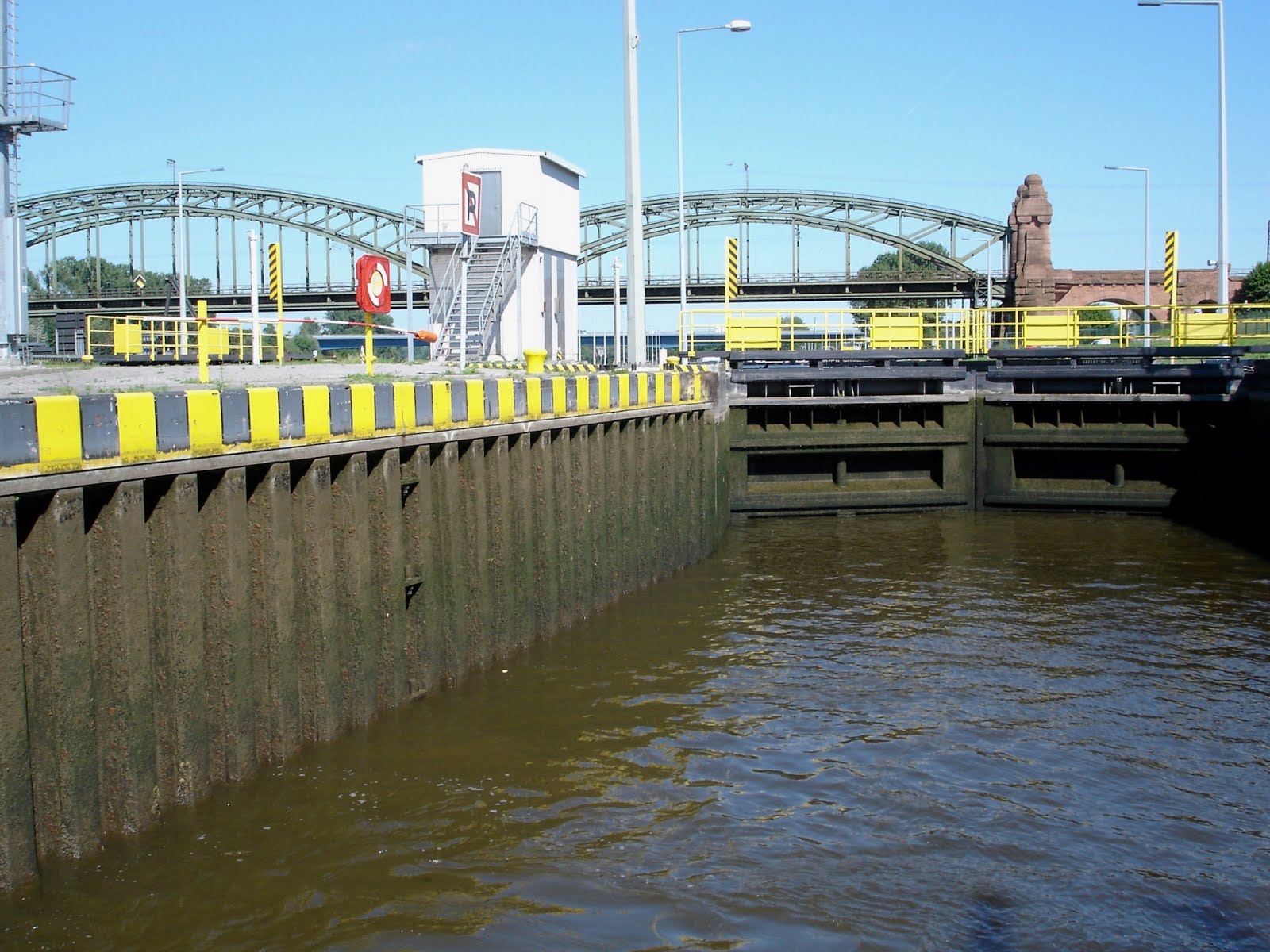

They're big enough to take the ship, of course and, at 20 metres, wider than Erin Mae is long! Glad we won't be facing too many of those when we resume our travels on the UK network!

Thursday, 25 May 2017

Castles in the air

In France it's the chateaux (so I believe). Down the Rhine gorge in Germany it's castles.


Most of those we passed today seemed to date from the 13th centre or thereabouts, though misfortune or the French resulted in many of them needing numerous phases of construction or repair over the centuries.


They appeared at regular half-mile intervals, each overlooking its village or small town. The family of one of them had enterprisingly set up a fortified toll post to make a small fortune from the traffic on the river…


The rest of the architecture along the banks was mostly typical of era and region.


Churches and houses followed similar patterns, except for this pair:


The building in front is a pub. The one behind, to which it is attached, is the church which owns the pub! This appears to date from when every monastery in this region, which has been growing vines since Roman times, produced its own vintage and sold it to help with the building fund.

Today's stop was at Rüdesheim – an archetypical wine-growing town given over, among other things, to a lot of tourism.


We headed for the most fabulous "Siegfried's Mechanical Music Museum", which has a glorious collection of mechanical music devices.


Boxes of this size (and there were a fair number) made a fair amount of fairground organ-type noise. This wonderful instrument…


worked on a pianola principle but, in addition to the keyboard, had half a dozen violins in the upper section which were also activated by the music roll. Magnificent!

Rüdesheim is also renowned for being the location of the "Niederwalddenkmal" monument, which you reach, if you want to avoid the climb, by cable car.


The top of the hill has large areas given over to woodland, where we got a nice, shady stroll, but the central attraction is the monument itself.


It was constructed in the 1870s to celebrate the victory of Germany in the Franco-Prussian war and the creation of the German Empire, and is topped by the figure of "Germania", holding a sword pointed down as a symbol of peace.

It's been a very nice day – the weather perfect for the things we've been doing. It's set to get warmer!

Wednesday, 24 May 2017

Heart of Europe

It seems we always go away from home just as the roses are getting in the mood. The red ones…


and the unusual Blue Moon…


and the rhododendron isn't in bloom for very long either…


But we had a date with a cruise ship in Cologne.


It's not a big ship, since this is a river cruise…


but it's quite a bit longer than Erin Mae!

We left Cologne and sailed through the night to tie up at Koblanz, where the Mosel flows into the Rhine. A guided tour took us round some interesting parts of the town, but what particularly captured my best beloved's eye were a couple of sculptures…


During lunch we sailed up to Bopppard, past some castles in this first part of the Rhine gorge.


Boppard is a delightful small town, where we're staying overnight.


It's a bit like parts of Cheshire we've visited on Erin Mae, except that the buildings are various shades of brown and white, instead of black and white!

We've completed only one full day, but already it feels like we've been here for far longer. And with the quality of the food, we're going to have to seriously watch our waistlines and perhaps make use of the fitness suite!

Sunday, 21 May 2017

Off and away

This being a year for celebrations, we're going cruising for a couple of weeks. But not on Erin Mae, and not in the UK. We'll be on board MS Charles Dickens, cruising the rivers of Europe, from Cologne to Budapest. We go out via Eurostar on Tuesday, and fly back to Gatwick in a fortnight's time. The weather forecast is looking great, the itinerary is splendid, and we are full of anticipation. We'll try and post pictures from time to time, if the WiFi works as promised.

Meanwhile, we're leaving Erin Mae in the hands of our good friends Brian and Christine, who will probably start out exploring the Staffs & Worcs. The only other occasion on which I was in Budapest, it was with Brian. We were part of a small convoy of minibuses driving out to Romania in the Spring of 1990. The Ceaușescu government had fallen just a few months earlier, and we were taking some material relief to mainly Baptist churches which had been under severe pressure from the regime. Initial contacts were with people in Timișoara, and then we went down to near the border with Serbia. Brian and Christine have been involved ever since with projects there aimed at supporting educational and rural development programmes.

So, if you see them on Erin Mae, give them a wave!

Thursday, 11 May 2017

Leading astray

I was doing the final testing following the configuring of Erin Mae's new tachometer, when I ran into another problem – the engine wouldn't stop! You normally stop it with the Stop button, before turning the ignition key back to position zero. Turning the key without stopping the engine first not only doesn't stop it, it also discharges the battery. Fortunately there's a lever on the side of the engine you can use to stop it in an emergency.

I took out the control panel yet again and found that, with all the fiddling around, a wire with a female spade connector was waving at me, having obviously come loose from its connection. But which one! The wire in question was the red half of a chunky 2-core cable which disappeared down towards the engine compartment. The blue half of the cable was attached to two thinner white wires, one of which could be traced to the stop switch, so this was obviously the culprit. But what was the wiring arrangement and where, among the various apparent options, should I re-attach the red core?

The white outer cover of the cable was a bit grubby, but I thought I could make out something written on it. Once it was cleaned I could read, in hand-written orange marker pen, "SUPPLY TO Q2". I knew that to be a breaker switch in the wiring cupboard and, fortunately, I have a PDF of Erin Mae's wiring diagram. That showed Q2 as controlling the horn and the headlight and I'd already noted that a similar chunky cable came up the control panel plinth and was attached in some way to the horn button and headlamp switch. The diagram also showed a straight connection from the ignition switch to Q2 – horn and headlamp are only supposed to operate when the engine is running. A continuity test with my multimeter revealed that the red and blue cores of the cable are joined at the bottom terminal of Q2, which explained things, though it didn't strike me as best wiring practice. The chunky cable is not only taking a 12 volt supply down to Q2 via its red core, but also, via its blue core, taking 12 volts back up again to be used by the Stop switch. Very odd!

The Isuzu marine engine manual shows the back of the ignition switch, and I was able to identify an available terminal which is live when the engine is running, but not needed for engine function. It was obviously a match for the loose wire's connector, so on it went. Nothing exploded or buzzed, the horn now operated again and, crucially, the engine stopped when I pressed the Stop button. Result!

Everything would now have been nearly perfect, but for one thing. The Stop switch has a little red acrylic cover printed with the word "Stop". With all the kerfuffle, it knocked on something, and broke. It's an ex-cover. You can't buy them for 50p, of course. You have to buy a whole new switch for 20 quid.

Tuesday, 9 May 2017

Revolutions and resolutions

The time finally came to fit the new tachometer. Over the New Year the supplier had eventually sent me the correct mini-wiring harness to adapt the new instrument to Erin Mae's wiring. The procedure for installing and configuring it seemed straightforward enough from the instruction sheet. Configuring it means telling it how many alternator impulses it will receive for every revolution of the engine, and I'd calculated there would be 8. You use a switch connected to one of the terminals to put the tachometer into "Pulse" mode and then to set the right number. That all seemed to go OK, so I started the engine to test it all. Nada. The needle stayed on zero.

Ouch! Perhaps I had never needed to buy a new tacho in the first place! Out came the voltmeter, and I eventually traced the problem to the simplest of all reasons – the sensor wire was broken just where it connected to the alternator  It was soon clear that a repaired wire would not be quite long enough so I needed a way of lengthening it, plus a new ring connector to attach it to the lug. I was just in time to nip down to the Maplin shop in Stafford and get some bits and pieces.

The wire was in, if not exactly the worst place imaginable, something close to it. The coolant hoses for the engine were right in the way of where I needed to have my wire-stripper/crimping tool. What should have been a simple process of joining two bits of wire became major exercise for both muscles and emotions. Eventually I cut all the plastic covering off a connector and managed to crimp it with my pliers. Then I added some solder for good measure and wrapped it in self-amalgamating tape. Finally I fixed the ring connector to the end of the extension piece and attached it to the lug on the alternator.

Now the engine test gave me a reading on the tacho, but it seemed too high. It showed 1000 rpm at tickover, whereas the old tacho had read about 650. I wondered if my assumption about the number of "poles" in the alternator had been correct. Internet sources had suggested 12, and that's what I'd used in the calculation. I posted a question on the CanalWorld forums and also emailed the manufacturer. 12 was indeed the right answer, but someone on the forum also suggested I could do some testing with a strobe/tachometer app for a smartphone. I found one, installed it on my best beloved's ancient iPhone, crouched down trying to get it to read the engine's speed of rotation, and so found myself eyeballing the engine's crankshaft pulley. I suddenly realised I'd used the wrong pulley data for the pulse number calculation. I measured the pulleys again, and found the number should have been 10, not 8.

So it was back to configuration mode, and this time the tachometer reads 800 rpm on tickover. That still seems a little high to me, but it may be that I need to re-programme my senses. Some time I'll get the strobe tacho app working and see what it says, or get a workshop to check the speed. No doubt that will be the point at which I will be consumed by an obsessive desire to get it pin-point accurate, and will seriously regret having sealed the control panel back in its place, rendering inaccessible the terminal to which I would need to attach my configuration switch. For the moment, however, we have tacho!

There's one final twist in this tale, but that can wait until tomorrow.

Monday, 8 May 2017

Getting ready

Over the last three weeks we've finally got back up to the marina to get Erin Mae ready for all sorts of things. Thankfully the various medical issues that afflicted me around Christmas seem to have been resolved, and we're now on our third visit north in as many weeks, fitting them in around other bits and pieces that have kept us occupied in the south.

It's been exciting! First was "de-winterisation" – basically getting the water systems back in operation. Doing it ourselves saves about £100 at both ends of the winter – it was only sheer terror at the prospect that made us get the workshop to do it the first few years. We've replaced the "candle" in the water filter under the sink, and in the process have gone back to getting a mere trickle of filtered water, far less flow than last year. It may be that we didn't have the filter properly in place before and so were drinking only partially filtered Adam's ale. Whatever, we seem to have survived it, but I don't think we'll repeat the experiment deliberately just for the sake of filling the kettle faster.

Secondly has been an operation with the audio. Erin Mae came with a rather nice DVD player / radio equipped with Dolby 5.1 electronics and speakers. All at an electrical cost, of course, and the twelvoltification operation meant dispensing with its services. However, we still wanted to be able to play music through something other than the laptop's own speakers. I found a small 12 volt amplifier on Amazon, and wired it up to Erin Mae's speaker system. To that I added a small device which links into the boat's WiFi network, so now I can stream music wirelessly from the laptop, with a minimum of fuss and, more importantly, a minimum of electrons. It's currently playing a nice album from Máiri Brennan which we haven't listened to for a long time.

Thirdly – the tachometer. It's never simple, is it! But this post runs the risk of being over-long, so I think I'll leave that tale until tomorrow.